
DeSoto Records for a Name Search
A careful DeSoto search begins by matching the record to the question. A parcel card can tie an owner or entity to a parcel, while a deed can show when an interest changed hands. A voter-status result is narrower, and a court index identifies a party or case rather than a home address. Vital, probate, license, and historical sources add dates and relationships when they are available through their own rules. None of these sources is a complete household list.
| Record | What It Can Confirm | DeSoto Search Route | Access |
|---|---|---|---|
| DCAD parcel card | Owner or entity, situs, mailing address, and legal description | DCAD owner search | Free online search; not a household roster |
| Dallas deed index | Grantor, grantee, instrument, and recording date | Dallas County OPR | Public index; copies and certificates have charges |
| Voter status | Registration status, county, and precinct where public | Texas My Voter Portal | Protected details remain restricted |
| Court or probate material | Party name, court matter, and docket trail | Dallas County record search | Sealed and confidential material is excluded |
| Vital event route | Whether an event can be verified or ordered | Texas DSHS forms | Recent records have eligibility rules |
| License or filing | Public credential or dated organizational role | SOSDirect and state boards | Role is not proof of a current residence |
Start with the most specific, least sensitive fact. A full name plus a street, a former surname, a case number, or a parcel legal description is stronger than a name alone. When checking a property owner, DCAD is often the first test. For a family-history question, probate, an obituary, or a directory date may be the better first record.
Confirm a DeSoto Resident Record
Same-name errors are common when confirming a DeSoto record. Keep the printed spelling, middle initial, suffix, and any former surname. Compare at least two independent anchors. DCAD’s account number and legal description can separate owners with the same name, while a court search needs a case number, court, date, or additional identifying detail. A mailing address on an appraisal card may belong to an office, agent, relative, or another parcel. It is a lead, not a conclusion about where someone lives.
- Use a name plus a DeSoto street, Dallas County, or another known detail to find a parcel or public voter-status lead.
- Save the stable identifier: a DCAD account, legal description, instrument number, or court case number.
- Check the Dallas County official-records index for a deed, release, probate item, or assumed-name filing that fits the same person and time.
- Use the court, vital, probate, or license custodian only for the narrow record needed to confirm the match.
Source view: Texas My Voter Portal is the official one-person status form used when the person is registered and the address is not protected.
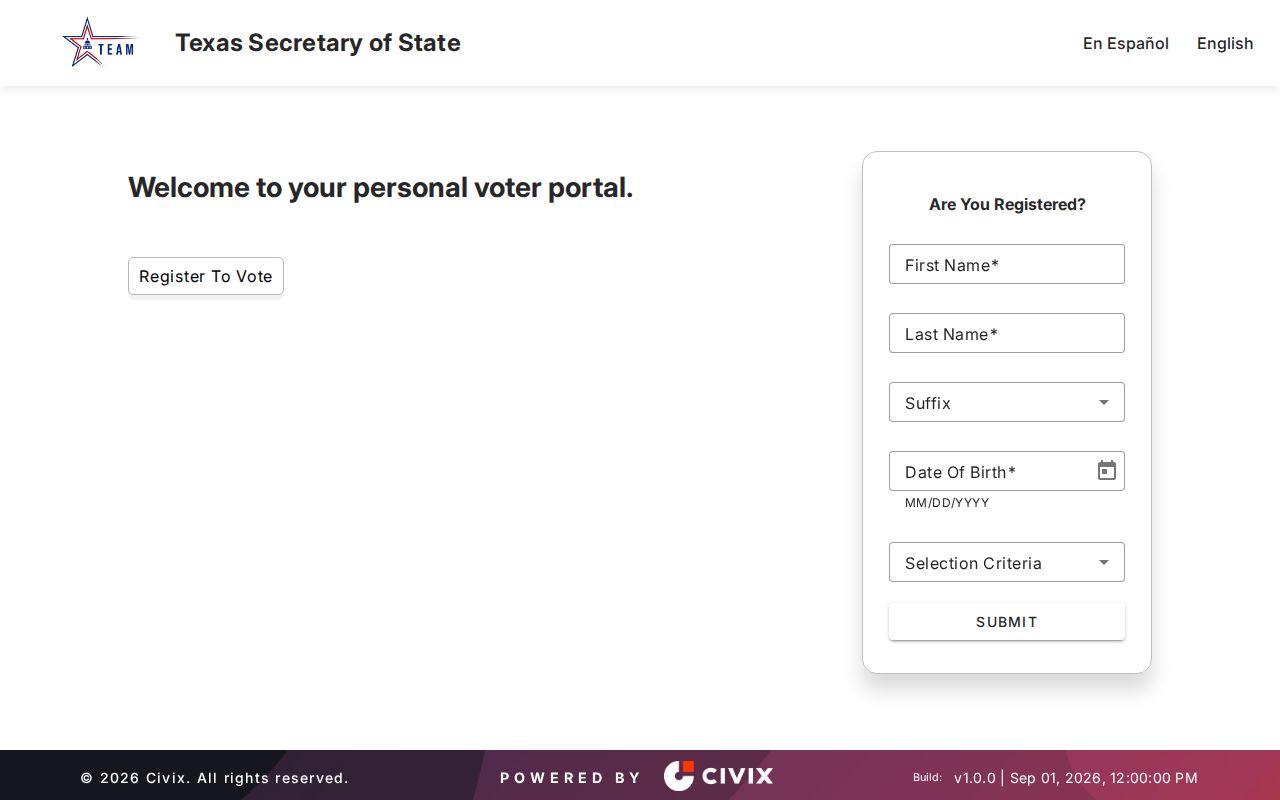
The portal’s name, county, date-of-birth, ZIP, and VUID routes help verify a limited voter-status lead without producing a block-wide roll.
A certified record is only needed when the custodian requires a formal copy or when a specific instrument must be relied on. The public index may be enough to identify the correct office and document number. The comparison should stop when the available records no longer support a careful match.
- Docket
- A court’s running list of case events, filings, settings, and orders.
- Index and image
- An index points to a record. An image is the scanned document itself and may have separate access or copy rules.
- Certified copy
- A custodian-issued copy authenticated for an official purpose, unlike an ordinary index result or plain copy.
Note: Keep the record identifier and the date searched so a later correction can be traced to the proper DeSoto or Dallas County custodian.
Check DeSoto Court Lookup Fields
Dallas County’s criminal search offers a name route and a case-number route. The name form requires a last name and can narrow with first or middle name, name type, race, sex, date-of-birth fields, number type, and pending status. Begin broad enough to find spelling or initial variations, then narrow. A hit becomes useful only after the case number, date, court, or other record detail aligns with the person being checked.
Source view: the Dallas County criminal search form displays its name and case-number search routes for this DeSoto court-verification step.
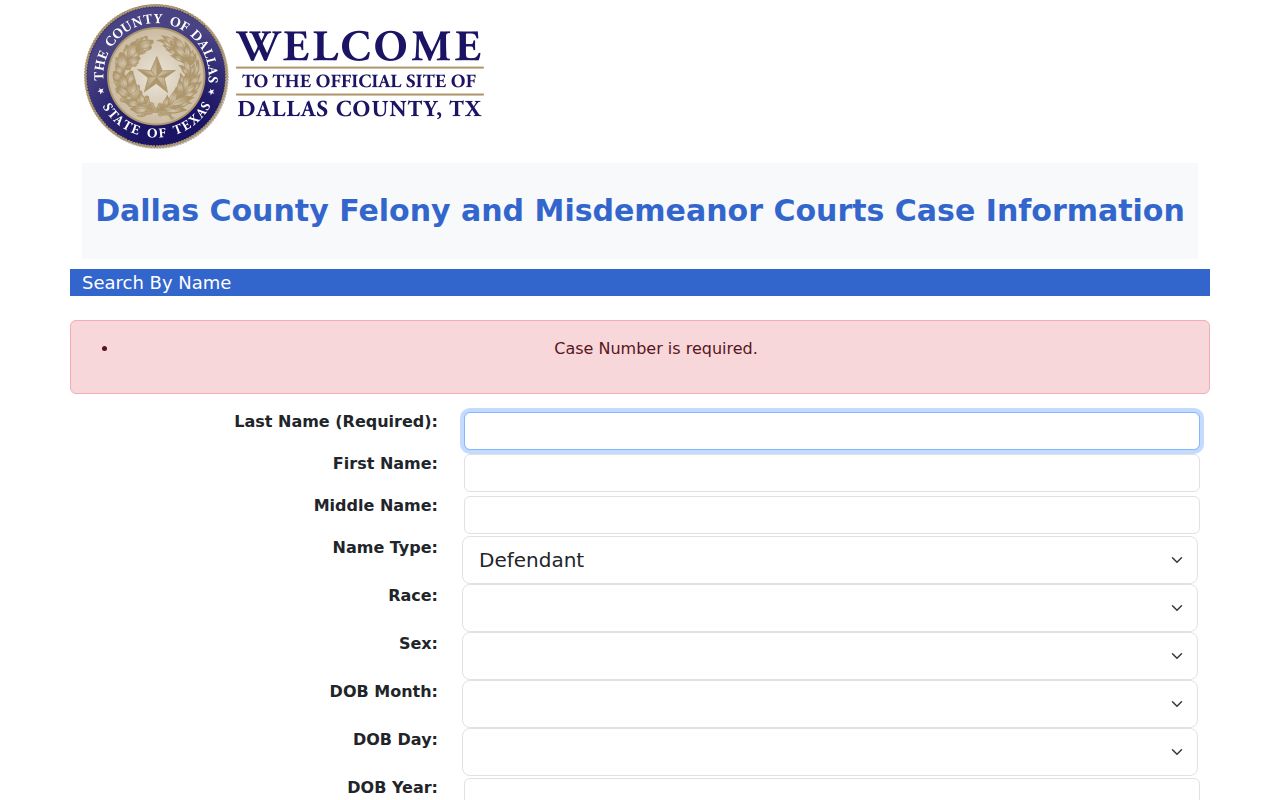
Its extra filters are a reason to narrow a same-name result with a case number, court detail, or additional custodian record before relying on it.
| Result Detail | Why It Matters |
|---|---|
| Case number | The key for a clerk request and the best way to avoid a same-name mix-up. |
| Style and party role | Shows how the name appears in the matter rather than assuming the person’s role. |
| Court and filing date | Places the result in the right Dallas County court and time period. |
| Case type and status | Helps distinguish an index lead from a final court record. |
| Docket entries | Point to filings or orders that must be requested from the custodian when available. |
Texas appellate Case Search uses different controls, including case number, partial case number, civil or criminal selection, filing-date range, style, attorney or bar number, trial-court case number, and county or court filters. It refreshes nightly and does not hold trial-court records. DeSoto Municipal Court is separate, and no public municipal name-search portal was located, so the clerk is the practical route for a narrow request.
Source view: the official Texas appellate search shows the court and case filters used for this DeSoto court route.
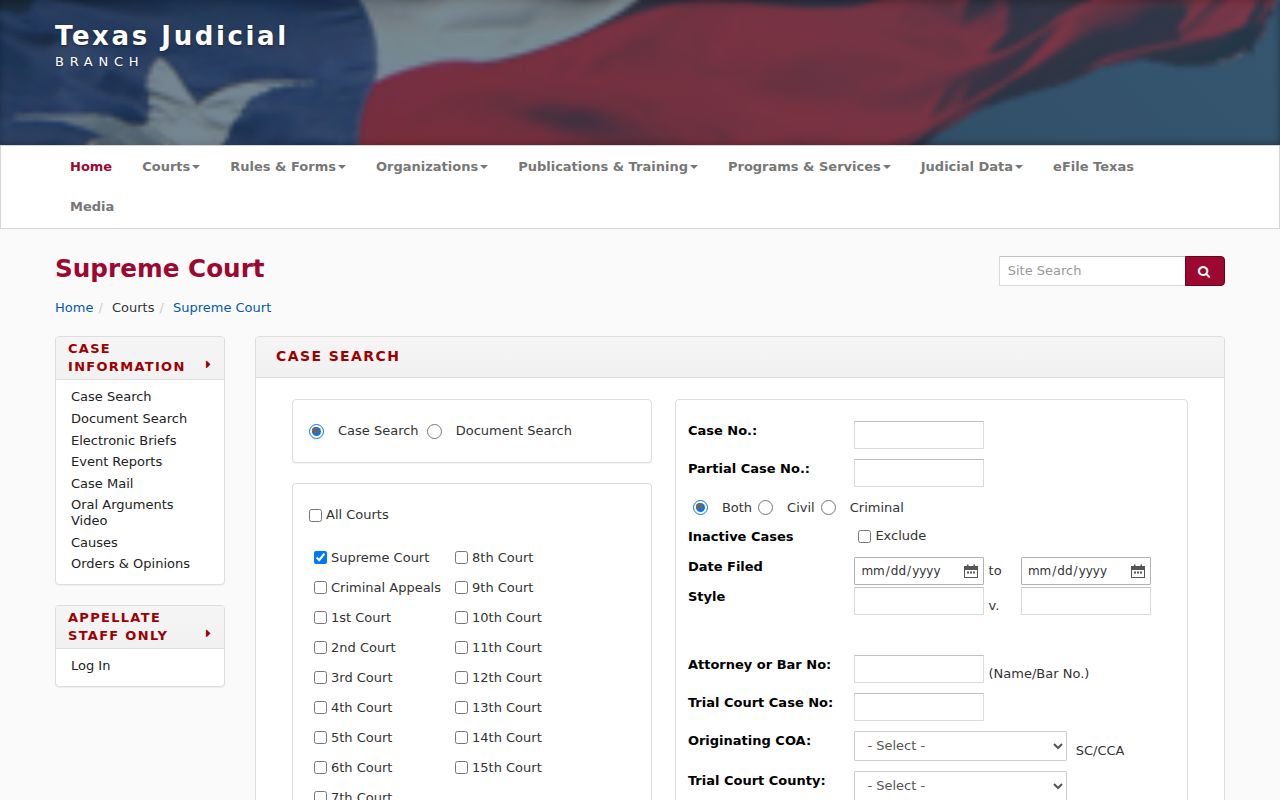
The image illustrates why an appellate search should be filtered by case or court context, rather than treated as a broad local resident index.
Resolve DeSoto Court Record Gaps
Court access in Dallas County has layers. Civil information begins in 1975, and most civil case files after 2008 are available through the district-clerk route. Family, juvenile, sealed, confidential, expunged, and restricted material is not a public online substitute for those files. The District Clerk’s civil and family records desk is at the George Allen Courts Building, 600 Commerce Street, basement B west, and its stated weekday hours are 8 to 4:30.
For probate, use the county portal or clerk to locate the exact docket, will, inventory, or order needed. An estate file may list an administrator, heir, attorney, or property reference, but private addresses in filings should not be repeated broadly. The county record-search hub permits public access without registration; statewide re:SearchTX is a separate route. Court absence is not proof that a DeSoto resident has no record, because coverage, spelling, migration, and sealing all matter.
Source view: the official Texas sex-offender registry offers name, area or address, and institution search modes with a public-record disclaimer.
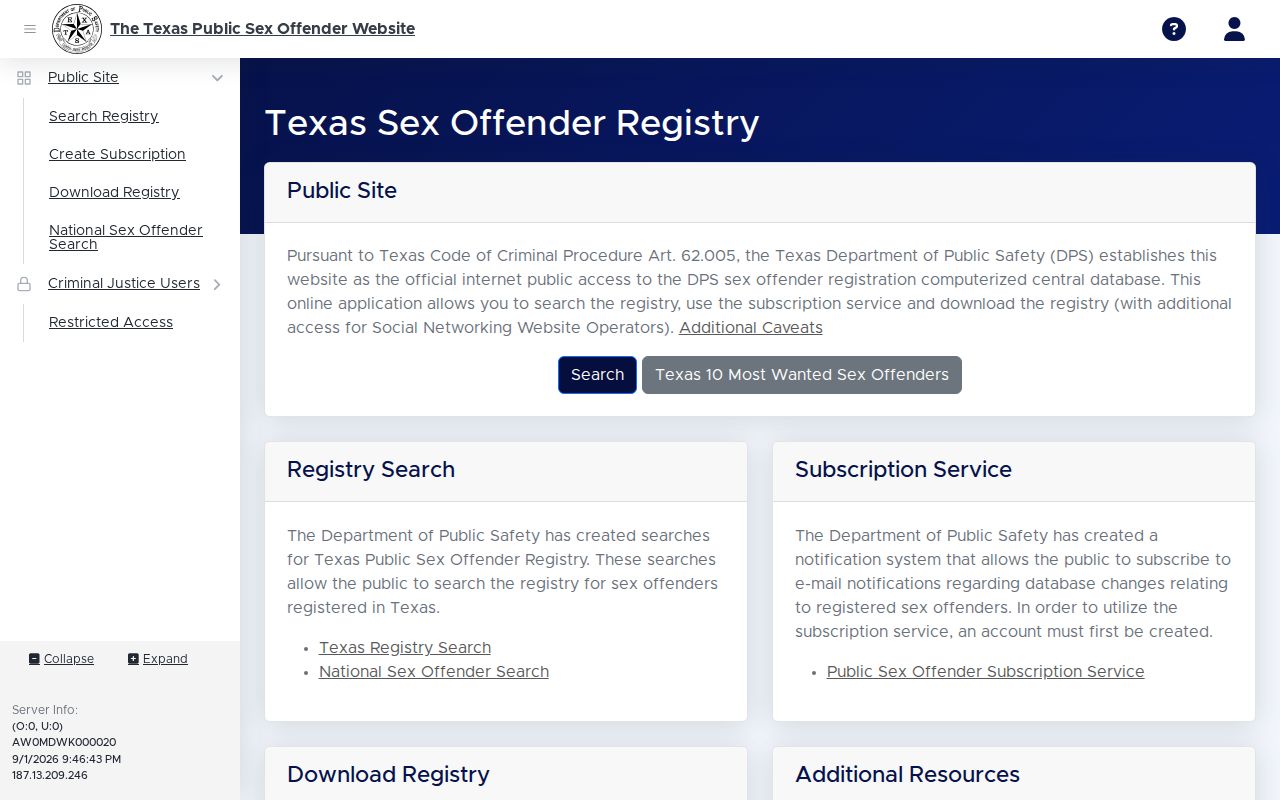
The registry has a narrow public-safety purpose and omits information such as Social Security numbers, driver-license numbers, phone numbers, victim information, and business-site details.
Note: The Dallas County criminal system cautions that older felony conversion data may contain errors, so a displayed result should be confirmed with the court custodian.
Use DeSoto Vital Lookup Rules
Texas Department of State Health Services handles statewide birth and death records, marriage and divorce verification, indexes, and request forms. Birth records become public on the seventy-fifth anniversary and death records on the twenty-fifth anniversary under the access periods identified in Texas Health and Safety Code section 192.005 and Government Code section 552.115. Before those dates, certified copies require a qualified applicant, direct tangible interest, legal authority, or the documentation specified by DSHS.
Texas birth and death records are stated as filed from 1903 forward. DSHS offers online, mail, Austin in-person, and local-office routes, and its procedure page lists a phone and email route for paper birth, death, and marriage or divorce verification requests. A marriage or divorce verification is not the county license or the district-court decree. For a Dallas County marriage, the County Clerk is the local route; for the actual decree, use the District Clerk.
For adoption or paternity matters, use the DSHS confidential process and lawful statutory channels. No open DeSoto name index or named official intermediary page was verified in the research. A name search should never try to infer confidential facts from unrelated public records.
Trace DeSoto Residents Through Heir Records
Probate, deeds, obituaries, directories, and library sources can help trace a historic DeSoto connection without claiming a current location. Search probate by the decedent’s name, then compare public docket, will, heirship, or order material with a deed transfer and obituary dates. Request only the specific case record needed. A later deed may identify a seller’s mailing address, but it does not guarantee that the address is current.
For a former classmate, pair a printed name with a school, graduating year, and city. Dallas Public Library, yearbooks, newspapers, local catalogs, and archives are better suited to that historical question than a modern property roll. The DeSoto city directory collections route explains the regional directory shelf, scattered Dallas-area coverage, and historical address clues in more detail. No official DeSoto alumni directory was located.
Dallas Public Library’s Bockstruck Genealogy Collection includes vertical files, Family Bibles, Veterans Oral History, Dallas Genealogical Society microfiche, FamilySearch Affiliate access, and local indexes. These are finding aids. Confirm any key fact with the office that holds the original record.
Confirm DeSoto Public Record Roles
Business and professional systems can confirm a public role, a credential, or a dated affiliation, but not a private residence. SOSDirect searches entity and assumed-name records and can expose filing number, registered agent, people, document images, and filing history where available. The Texas Comptroller public-information route, DCAD business personal property search, state licensing boards, and DeSoto permit channels can add context for a business question.
Texas licensing sources are separated by field. TDLR can search by registration type, number, name, city, county, or ZIP. The Medical Board, Board of Nursing, Behavioral Health Executive Council, State Bar, and educator certificate lookup each publish their own status information and limits. A registered agent, organizer, officer, or license holder is a recorded role. It should not be converted into a claim about present DeSoto residence.
If no public portal holds the narrow record needed, use the Texas Public Information Act, Government Code chapter 552, with the right custodian. A city request should identify the record, date range, and address or identifier. A County Clerk document request can use grantor or grantee, instrument number, document type, property address, and copy type. Broad requests for all documents invite clarification and may not produce a useful answer.
Source view: the DeSoto open-records request instructions identify the city route and its JustFOIA transition for a focused records request.
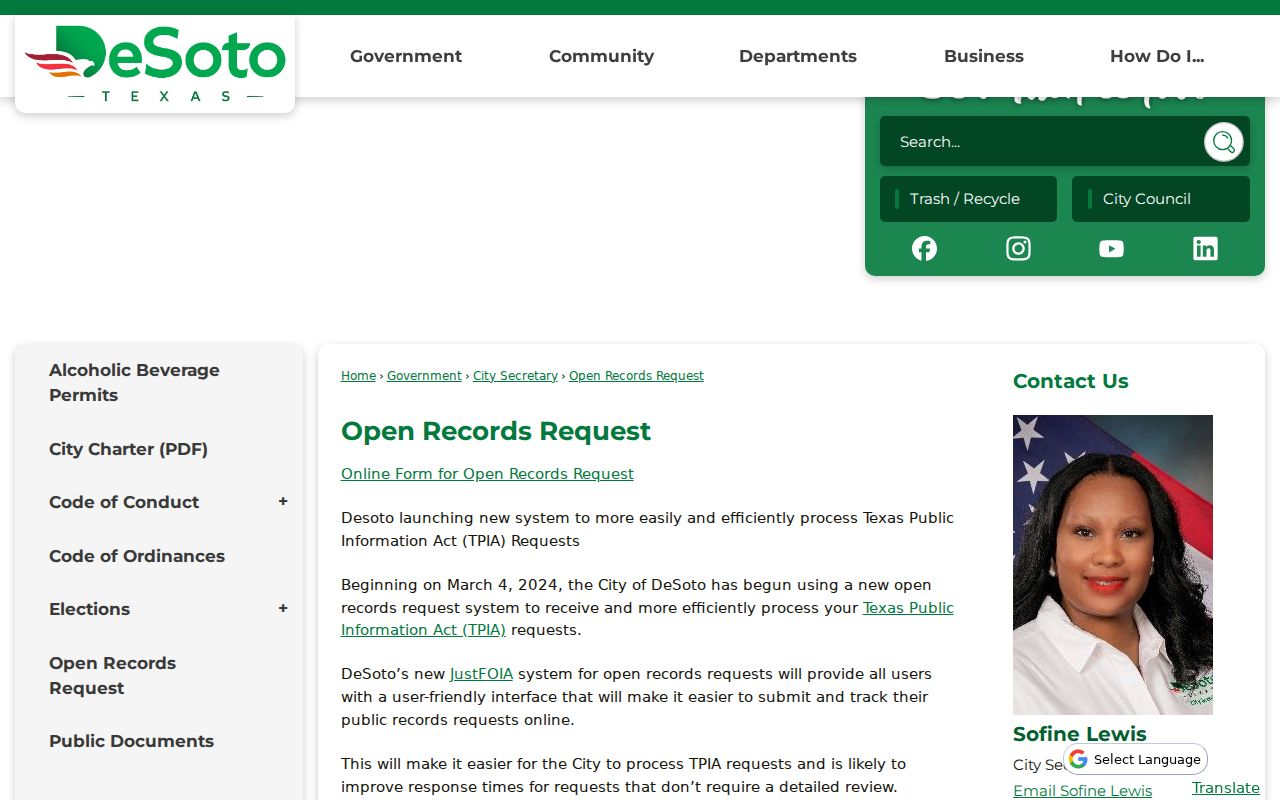
The city process is most useful when it names a known record and a date range, rather than seeking an unrestricted list of people or documents.
Respect DeSoto Resident Record Privacy
A DeSoto record search has firm boundaries. Current occupants, private household members, utility subscribers, motor-vehicle address data, protected voters, sealed files, and private organization rosters are not reliable public sources. Texas Election Code section 13.004 protects Social Security, driver-license, and DPS identification information. Election-law protections can also suppress a qualifying voter’s address. A voter result does not reveal a ballot choice.
The Texas Address Confidentiality Program provides an eligible survivor or qualifying household member with a substitute mailing address and mail-forwarding route. Texas Data Privacy and Security Act rights, effective July 1, 2024, apply through a business’s privacy channel and do not erase government deeds, court dockets, or voter records. The Data Broker Act has separate registration and notice duties. Correct a wrong entry at the source, keeping the record identifier and supporting document for the appraisal district, clerk, registrar, court, board, or database involved.
Lawful use. Use DeSoto resident records for personal, lawful research, family history, estate questions, or civic curiosity. Never use a record to stalk, harass, intimidate, or harm another person.